


Light pollution
By Katharina Zeuner|
When light ends up where it doesn’t belong
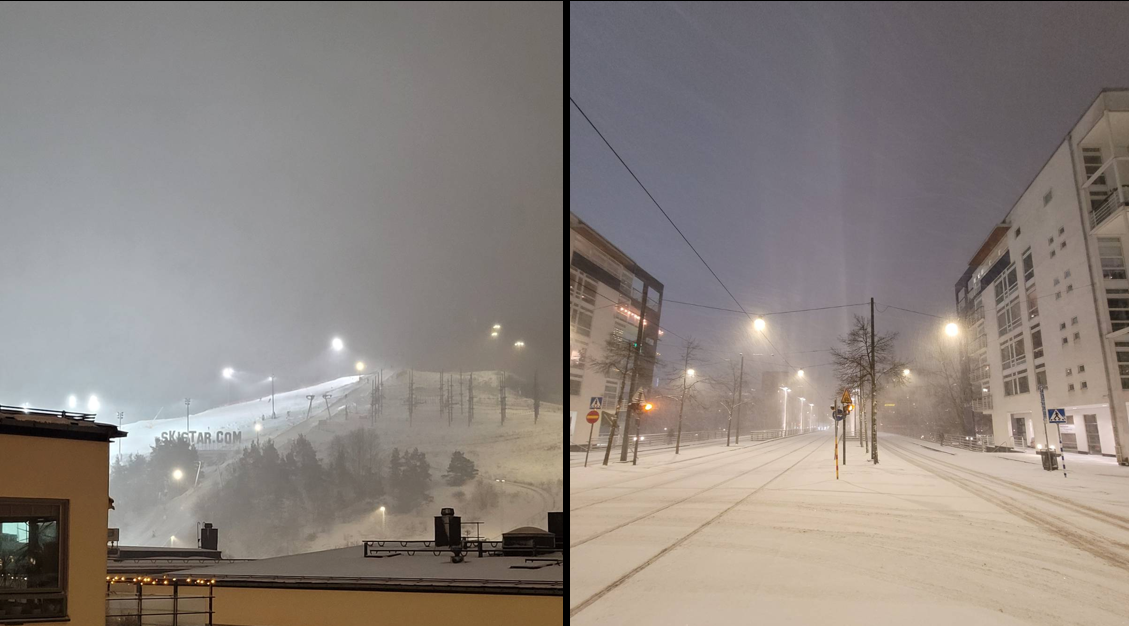
Living in Stockholm has its perks – one of them is having a ski slope within walking distance. It’s so close that I can see it from our living room. In the evenings, the floodlights illuminating the slopes are glaringly visible from our dinner table.
Those lights don’t only illuminate the slopes. They also spill into the surroundings, to the point where even my colleague on the neighboring island can see them. This is a prime example of light pollution. Light pollution is artificial light that is (intentionally or unintentionally) present in otherwise dark conditions. It can take many forms:
- Glare, reducing visual comfort and contrast
- Skyglow, the bright haze above cities
- Over‑illumination and light clutter, distracting or obscuring what we actually want to see
It is a by‑product of urbanization and has increased rapidly in recent decades. Today, 99% of Europe’s population and biodiversity live under light‑polluted skies [1].
LEDs – part of the solution, part of the problem
Since around 2010, LED lighting has largely replaced incandescent, fluorescent, and halogen lamps. LEDs use less energy and last much longer – which is great. However, there is a rebound effect. Because lighting becomes cheaper to operate, we tend to install more of it or keep it on for longer. The result is more artificial light at night and increased skyglow, both in brightness and geographical reach. Satellite data shows that between 2011 and 2022, the average night sky became about 10% brighter every year – meaning it doubles in brightness roughly every eight years [2]. These numbers might be underestimating the problem as spectral response of the used radiometer doesn’t cover the full LED spectrum [3].
Why does light pollution matter?
Light pollution isn’t just an annoyance for people who enjoy dark evenings. Almost every species studied is affected by artificial light at night.
- Wildlife: It disrupts daily and seasonal rhythms such as migration, feeding, hiding, and reproduction, and weakening ecosystems in the long run [4]. Just to name a few examples here:
- Fish and zooplankton as deep in the arctic sea as 200 m can react to lights from ships in the otherwise pitch-black polar night [5].
- Artificial light can interfere with natural cues to start the breeding season of wild mammals [6].
- The leaf morphology in herbaceous plants can change in the presence of LED lights, leading to reduced net photosynthesis [7].
- Humans: Artificial light can disturb circadian rhythms, affecting sleep and health. More light does not automatically mean better visibility or safety – Bright lights can cause visual discomfort and harsh contrasts can make objects outside of the brightly lit area harder to see.
- Astronomy: For hobby astronomers (and professionals alike), light pollution makes observing the night sky increasingly difficult, even in remote areas.
Light is an environmental pollutant – but unlike many others, it can be reduced immediately by changing how we design and use lighting.
For optics nerds: what can we do about it?
If you design illumination systems, the good news is that many mitigation measures are technically straightforward.
Key principles for responsible outdoor lighting [8]:
- Direct the light: Avoid upward emission. Shield luminaires and minimize emission near the horizon (especially 90–100°).
- Use adaptive controls: Dim or switch lighting based on traffic or occupancy.
- Choose spectra carefully: Short wavelengths scatter more and contribute more strongly to skyglow and circadian disruption.
- Use shielding where high intensities are needed: For example, in greenhouses, to protect surrounding ecosystems.
DarkSky.org provides a clear infographic summarizing these principles:
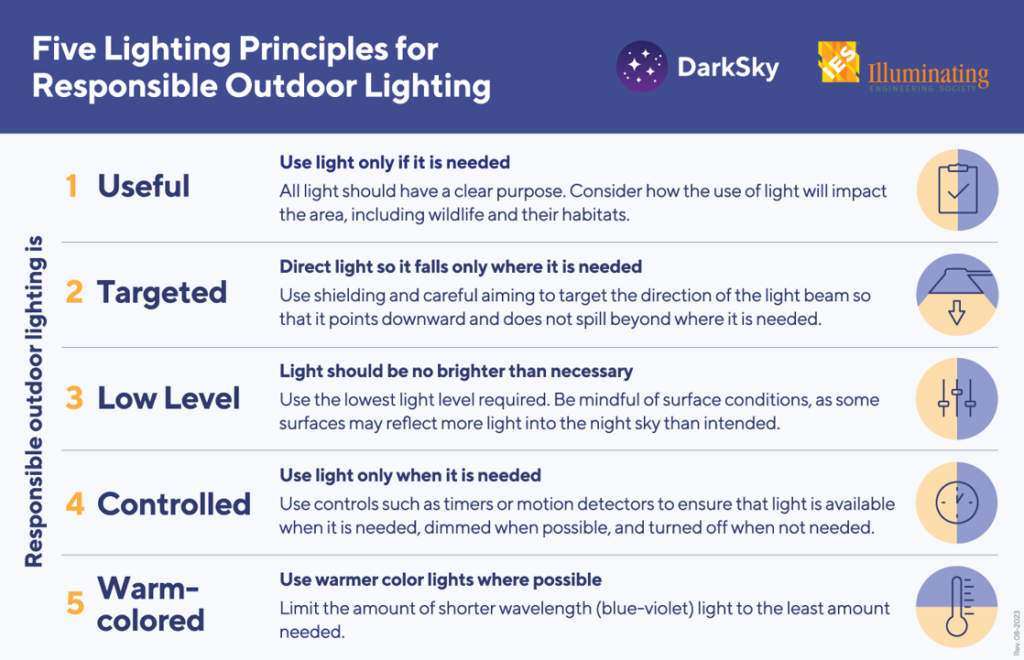
Principles for Responsible Outdoor Lighting, from DarkSky.org.
In essence: Illuminate only what is needed, when it is needed, and no brighter than necessary.
A simple illustrative calculation
Let’s look at a rough calculation for the ski slope example:
- 30 floodlights
- 6 lamps each
- 500 W per lamp
- 30% of the light misses the target
That results in:
30 × 6 × 500 W × 0.3 ≈ 27 kW of wasted power.
With 6 hours of operation per day over 90 days, this amounts to roughly 15 MWh per season. If we consider that one medium-sized household/apartment consumes on average 3000 kWh per year (according to Vattenfall). So instead of unintentionally illuminating the sky, we could use that energy to supply a few households with electricity for a year.
Light pollution and sustainability
While there are currently no centralized EU regulations specifically addressing light pollution, momentum is building through research projects and policy initiatives [1], [9]. These projects have already produced a policy brief that provides strategic guidance for the European Union on how to acknowledge and address light pollution. As sustainability is a topic that is close to our hearts here at Eclipse, we also want to summarize how light pollution or rather its prevention touches all 3 pillars of sustainability:
- Environmental: Protects wildlife, especially in nocturnal ecosystems
- Economic: Reduces wasted energy and operating costs
- Social: Improves visual comfort and can support better sleep and well‑being
If you enjoyed this article, keep an eye out – more content on optics and sustainability is coming soon.
Further reading
[1] Yakushina, Y. (2025). Policy Brief Restoring the Night: A Policy Agenda for Light Pollution Mitigation in Europe. https://plan-b-project.eu/.
[2] Kyba, C. C. (2023). Citizen scientists report global rapid reductions in the visibility of stars from 2011 to 2022. Science, 265-268.
[3] Miller, S. D. (2013). Illuminating the Capabilities of the Suomi National Polar-Orbiting Partnership (NPP) Visible Infrared Imaging Radiometer Suite (VIIRS) Day/Night Band. Remote Sensing, 6717-6766.
[4] Barentine, J. (2025). Artificial Light at Night: State of the Science 2025. Zenodo.
[5] Berge, J. (2020). Artificial light during the polar night disrupts arctic fish and zooplankton behaviour down to 200m depth. Communications Biology.
[6] Robert, K. (2015). Artificial light at night desynchronizes strictly seasonal reproduction in a wild mammal. Proc Biol Sci.
[7] Dani, M. (2021). The sensitivity of herbaceous plants to light pollution. ACTA Universitatis, Sectio Biologiae.
[8] Karlicek, R. (2017). Handbook of Advanced Lighting Technology. Springer.
[9] Yakushina, Y. (2023). Manifesto for Tackling Light Pollution & Proposing EU Light Pollution Monitoring. Zenodo.